The AI "Grandparent Scam": How Your Loved One’s Voice Can Be Weaponized
02/10/2026
by P. Birmingham
In today’s world, technological advances have revolutionized how we communicate, work, and interact with the digital environment. Among the most impressive—and simultaneously alarming—of these advances is artificial intelligence (AI)-driven voice cloning. This technology allows anyone with a sample of a person’s voice to generate highly realistic audio that mimics that person’s speech patterns, tone, and cadence. While voice cloning has legitimate applications in entertainment, accessibility, and personalized technology, it has also opened the door to a growing wave of cybercrime known as “Grandparent Scams,” where criminals exploit these lifelike voices to deceive and defraud unsuspecting victims.
Understanding AI-Driven Voice Cloning
Voice cloning is the process of creating a digital model of someone’s voice that can produce speech indistinguishable from the real person. Traditional voice synthesis relied on pre-recorded audio samples strung together, producing robotic or unnatural speech. Modern AI-driven voice cloning, however, leverages deep learning techniques—particularly neural networks—to understand the nuances of human speech.
How It Works
Voice Data Collection: The process begins with collecting audio samples of the target voice. These samples can range from a few seconds to several hours of speech. In many cases, a short sample of 30 seconds can be sufficient for advanced AI systems to replicate a voice convincingly.
Training the AI Model: The collected data is fed into a deep learning model, often using architectures like recurrent neural networks (RNNs) or transformers. The AI analyzes features such as pitch, tone, accent, pace, and speech rhythm to create a detailed digital representation of the voice.
Voice Synthesis: Once trained, the AI model can generate new speech in the cloned voice. The output can read any text input, making it possible to produce custom messages that sound as if they were spoken by the original person.
Refinement: Many systems include post-processing steps to enhance clarity, reduce noise, and adjust emotional tone, resulting in output that is nearly indistinguishable from real human speech.
The sophistication of this technology has improved rapidly. Just a few years ago, voice cloning required hours of high-quality audio and extensive technical knowledge. Today, cloud-based AI tools and user-friendly apps make it possible for anyone to clone a voice with minimal effort.
The Rise of “Grandparent Scams”
While AI voice cloning has promising applications, it has also become a tool for cybercriminals. One of the most insidious uses is in “Grandparent Scams.” These scams exploit the trust and emotional bonds between older adults and their families, often leading to financial loss and emotional trauma.
How Grandparent Scams Work
The typical scenario involves a scammer contacting an elderly individual while impersonating their grandchild or another family member. In traditional versions of this scam, the criminal might rely on social engineering, phone calls, or email to convince the grandparent that their loved one is in urgent trouble and requires immediate financial help.
With AI-driven voice cloning, the scam has become far more sophisticated:
Targeting the Victim: Criminals identify potential victims through public social media profiles, public records, or even leaked databases. They look for elderly individuals who are likely to respond emotionally to messages from family members.
Obtaining a Voice Sample: Scammers might collect public audio recordings, such as videos posted on social media, voice messages shared with friends, or interviews. Even a short clip can be enough to train a voice-cloning AI.
Creating a Cloned Voice: Using the AI, the criminal generates a voice message that sounds exactly like the victim’s grandchild. This message typically conveys a sense of urgency, fear, or distress, such as, “Grandma, I’m in trouble. I need you to send money immediately.”
Exploiting Emotional Response: Older adults often respond emotionally to a loved one’s apparent distress. The scammer leverages this emotion to instruct the grandparent to transfer money via wire transfer, gift cards, or cryptocurrency—methods that are difficult to trace or recover.
Monetary Extraction: Once the payment is made, the criminal disappears, leaving the victim confused, anxious, and financially harmed.
Real-World Examples
The rise of AI voice cloning scams has already been documented. In 2019, a German energy company employee was tricked into transferring €220,000 after receiving a call that perfectly mimicked his CEO’s voice. The scammer used AI to replicate the CEO’s British accent and speech patterns. Although this case did not involve a grandparent, it demonstrated the potential for voice cloning to enable highly effective financial fraud.
Since then, reports of similar scams targeting elderly individuals have grown, with victims sometimes losing tens of thousands of dollars. In many cases, victims describe feeling emotionally manipulated rather than simply defrauded, which highlights the psychological dimension of these attacks.
Why AI Voice Cloning is Dangerous in This Context
Several factors make AI-driven voice cloning particularly effective for Grandparent Scams:
Authenticity: Older adults are less likely to question a voice they recognize. Unlike traditional scams that might use a generic or unfamiliar voice, cloned audio can replicate subtle speech quirks that build credibility.
Real-Time Interaction: Some scammers combine voice cloning with real-time conversation tools, allowing them to respond dynamically and make the interaction even more convincing.
Ease of Access: Previously, voice synthesis required significant technical expertise. Today, off-the-shelf software and cloud-based AI services lower the barrier to entry for criminals.
Anonymity: Scammers can operate remotely and remain anonymous while creating convincing interactions, making law enforcement intervention more difficult.
Psychological Manipulation: By simulating a distressed loved one, criminals trigger strong emotional responses, overriding rational decision-making.
Recognizing the Signs of a Grandparent Scam
Awareness is the first line of defense. Families and individuals can look for certain warning signs that may indicate a voice cloning scam:
Unexpected Urgency: Any call or message demanding immediate action or financial transfer should raise suspicion.
Unusual Payment Methods: Requests for wire transfers, gift cards, or cryptocurrency are common red flags.
Inconsistencies in Communication: Even highly accurate clones may mispronounce words, use odd phrasing, or fail to recall personal details correctly.
Pressure Tactics: Scammers often insist on secrecy, discouraging the victim from checking with other family members.
Unsolicited Contact: Calls or messages from family members that the recipient was not expecting should be verified.
Preventive Measures
Preventing Grandparent Scams requires a combination of technology awareness, family communication, and practical safeguards.
Verify Before Acting: Encourage older family members to always verify any urgent financial requests with another trusted relative. A simple call to the actual grandchild can prevent most scams.
Educate About AI Threats: Families should discuss the existence of voice cloning and explain that even familiar voices can be faked.
Secure Personal Data: Limit sharing of voice recordings, video messages, and other personal data online. Public social media content can be harvested by scammers to create voice models.
Financial Safeguards: Consider setting daily transaction limits, alerts for large transfers, and requiring dual authorization for significant payments.
Report Suspicious Activity: Contact local authorities, banks, or fraud prevention agencies immediately if a scam attempt occurs. Reporting helps law enforcement track emerging patterns and prevent further victimization.
Use Technology Defenses: Certain AI tools can detect synthetic voices by analyzing audio patterns that are unnatural or inconsistent with human speech. While these tools are not yet mainstream, they may become a critical line of defense in the future.
Broader Implications of Voice Cloning Scams
The threat of AI-driven Grandparent Scams highlights the broader societal risks of advanced synthetic media. Beyond financial fraud, voice cloning can be used for:
Political Manipulation: Impersonating public figures to spread misinformation or manipulate elections.
Corporate Espionage: Cloning executives’ voices to authorize fraudulent transactions or gain sensitive information.
Identity Theft: Using cloned voices to bypass biometric security systems or authenticate fraudulent accounts.
The ethical, legal, and regulatory landscape around AI voice cloning is still evolving. Governments and technology companies are exploring measures such as watermarking synthetic audio, imposing stricter verification protocols, and penalizing malicious uses of AI-generated voices.
The Role of AI Companies and Ethical Considerations
AI developers play a critical role in mitigating these risks. Ethical design principles can reduce abuse without stifling innovation. Key strategies include:
Usage Restrictions: Limiting access to high-fidelity voice cloning to verified users or licensed purposes.
Consent Requirements: Ensuring that voices cannot be cloned without explicit permission from the individual.
Detection Mechanisms: Embedding subtle watermarks or markers in AI-generated audio that indicate its synthetic nature.
Public Awareness Campaigns: Educating users about potential misuse and signs of synthetic media.
Balancing innovation and security is challenging. Voice cloning has transformative potential in entertainment, accessibility, and communication for people with speech impairments. At the same time, unchecked access could exacerbate financial fraud, psychological manipulation, and identity theft.
Preparing for the Future
As AI voice cloning becomes increasingly sophisticated, society must adapt. For individuals, especially older adults, education and vigilance are crucial. Families should maintain open communication and create verification habits for any urgent requests. Financial institutions and law enforcement agencies must stay informed about emerging scam techniques to respond quickly and protect vulnerable populations.
On a broader scale, policy makers and technology developers must collaborate to establish ethical frameworks, detection tools, and legal protections. Transparency in AI-generated content, coupled with public awareness, can mitigate many of the risks associated with this technology.
Conclusion
AI-driven voice cloning represents one of the most impressive achievements of modern artificial intelligence, enabling remarkably realistic synthetic speech. However, the very realism that makes it remarkable also makes it a powerful tool for deception. “Grandparent Scams” illustrate the human cost of this technology, exploiting trust, love, and emotional vulnerability to commit financial fraud.
Preventing these scams requires a multifaceted approach: education, verification, financial safeguards, and ethical AI development. By staying informed and vigilant, families can protect themselves against the emotional and financial damage caused by these crimes. Meanwhile, the broader society must continue to address the ethical and regulatory challenges posed by AI-generated media to ensure that innovation enhances human life rather than undermines it.
The intersection of AI and social engineering demonstrates that technological progress, while beneficial, can also amplify human vulnerabilities. As AI voice cloning continues to advance, awareness, preparation, and ethical oversight will determine whether this technology becomes a tool for empowerment or a vector for exploitation.
About Author:P. Birmingham founded Stunster.com in 2007 and has nearly two decades of hands-on experience with non-lethal self-defense tools, including TASER® devices, stun guns, pepper sprays and pepper guns. He works directly with distributors to ensure products meet high standards of reliability and usability. His mission is to help everyday people understand personal defense technology and make confident, informed choices.



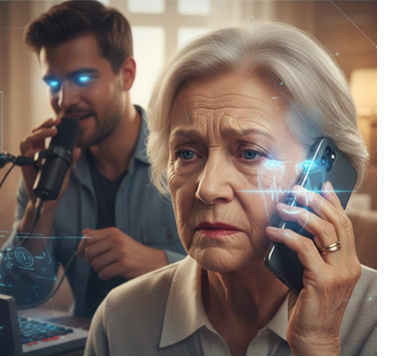 In today’s world, technological advances have revolutionized how we communicate, work, and interact with the digital environment. Among the most impressive—and simultaneously alarming—of these advances is artificial intelligence (AI)-driven voice cloning. This technology allows anyone with a sample of a person’s voice to generate highly realistic audio that mimics that person’s speech patterns, tone, and cadence. While voice cloning has legitimate applications in entertainment, accessibility, and personalized technology, it has also opened the door to a growing wave of cybercrime known as “Grandparent Scams,” where criminals exploit these lifelike voices to deceive and defraud unsuspecting victims.