by P. Birmingham
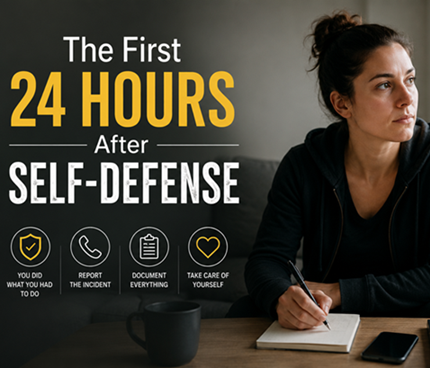
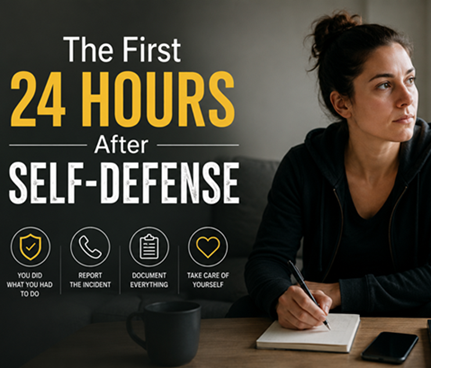 You've trained. You've carried responsibly. You've read up on your state's self-defense laws. Then the unthinkable happens — and you successfully defend yourself.
You might think the hard part is over.
It isn't.
In the experience of criminal defense attorneys nationwide, more legitimate self-defense claims are lost in the 24 hours after the incident than during the incident itself. Adrenaline-soaked statements to police. Well-meaning Facebook posts. Conversations with EMS workers who later get subpoenaed. Innocent-sounding answers to "just a few questions" at the police station. Each one can take a textbook self-defense case and turn it into a manslaughter charge or a six-figure civil lawsuit.
This guide walks you through what experienced self-defense attorneys recommend for those critical first 24 hours — covering pepper spray, stun gun, Taser, and any other less-lethal defensive use of force. The principles apply whether you used a Taser, pepper spray, your fists, or any other tool.
The Two Realities Most People Don't Know About
Before we get into the timeline, two facts shape everything that follows:
Reality #1: The first person to call 911 is treated as the victim. Police and dispatchers tend to operate on a simple working assumption: whoever calls 911 first is treated as the victim, and whoever gets called on is treated as the suspect. It's not always fair, but it's how the system functions in practice. If you defended yourself and your attacker (or one of their friends) calls 911 first, officers may arrive assuming you are the aggressor.
Reality #2: Your brain is not reliable for the next several hours. During and after a high-adrenaline event, your prefrontal cortex — the part responsible for sequencing, time perception, and detailed recall — partially shuts down. This is basic biology. Even police officers involved in shootings are typically given 24 to 48 hours before being asked to give a detailed statement, because departments have learned that immediate statements are full of inaccuracies that later look like "lies" to a jury. You deserve the same protection.
Hold onto these two facts. They explain almost every recommendation that follows.
Hour 0: The Moment the Threat Ends
The instant the attacker is no longer a threat — they've fled, they're incapacitated, or they've stopped advancing — your legal status changes. Continuing to use force after the threat has ended converts justified self-defense into assault. Stop. Create distance. Get to a position of safety.
Then, immediately:
- Check yourself for injuries. Adrenaline masks pain. You may be hurt and not know it.
- Scan for additional threats. Was the attacker alone? Are bystanders safe?
- Secure your defensive tool. If you used pepper spray, put the canister down or back in its holster. If you used a stun gun or Taser, switch the safety on. You do not want to be holding a weapon when police arrive.
Hour 0-1: Calling 911
Call 911 yourself, and call first. This is the single most important tactical decision in the aftermath. Being the first caller establishes you in the system as the victim, not the suspect.
What to say to the dispatcher, based on guidance from criminal defense attorneys and self-defense legal organizations like USCCA, U.S. LawShield, and the Armed Citizens' Legal Defense Network:
"I was attacked. I was in fear for my safety. I defended myself. I need police and an ambulance at [address]."
That's it. That's the whole script.
What NOT to say to the dispatcher:
- Don't describe exactly what you did. ("I sprayed him three times in the face.")
- Don't speculate about the attacker's intent. ("I think he was going to rob me.")
- Don't minimize. ("I wasn't sure if he really had a weapon.") Phrases like "I think," "I believe," or "I wasn't sure" can later be used to argue your fear wasn't reasonable.
- Don't apologize, joke, or make small talk. The 911 call is recorded and will likely be played in court.
If the dispatcher presses for more details — and they often will — you can simply repeat: "I was attacked. I defended myself. Please send help."
Stay on the line if asked, but keep your statements short and factual.
Hour 1: When Police Arrive
Police rolling up to a self-defense scene are responding to an unknown situation. They don't know yet who is the victim and who is the suspect. They are trained to treat the scene as potentially dangerous.
Make yourself non-threatening:
- Put down any defensive tool before officers arrive, in plain view, away from your body.
- Keep your hands visible — open palms, away from your waistband and pockets.
- Follow every instruction immediately, even if it includes being handcuffed or sat on the curb. Being detained is not the same as being arrested. Arguing in this moment will not help you.
- Identify yourself as the victim: "I'm the one who called. I was attacked."
Then — and this is critical — invoke your rights.
There are two schools of thought among self-defense attorneys about exactly how to handle the next conversation with police, and you should know both:
Approach A: The "Brief Statement" Method
Recommended by a number of pro-Second Amendment attorneys, including some former prosecutors. The idea: give a very short, controlled statement to ensure the investigation begins on the right footing, then stop talking. A typical brief statement covers five points:
- "I was the victim of a crime."
- "That person attacked me." (Point at the attacker.)
- "I will sign a complaint."
- "The evidence is over there." (Point out weapons, witnesses, and physical evidence.)
- "I will fully cooperate after I speak with my attorney."
Then stop. The reasoning: pointing out evidence and witnesses while they're still there protects your case, and identifying yourself as the victim reduces the chance of being charged.
Approach B: The "Say Nothing" Method
Recommended by most criminal defense attorneys as the safer default. The idea: anything you say can and will be used against you, and you cannot reliably give a statement under adrenaline. Your script:
"Officer, I want to cooperate fully. I will give a complete statement after I speak with my attorney. I am invoking my right to remain silent and my right to counsel."
Repeat that sentence as many times as needed. Do not answer follow-up questions, no matter how friendly the officer seems.
Which Approach Is Right?
This is genuinely a judgment call that depends on your training, your state, your composure, and the specific facts. The safer default for most people is Approach B. The brief-statement approach can backfire badly if you say one wrong word — and adrenaline makes wrong words more likely.
What both approaches agree on absolutely:
- Never give a detailed narrative on scene.
- Never lie. If asked whether you have a weapon, answer truthfully.
- Always invoke your right to counsel clearly and verbally. Saying "I want a lawyer" is a constitutional shield. Mumbling "Maybe I should talk to someone" is not.
Hour 1-3: Common Police Tactics to Recognize
Officers are not your enemies, but they are also not your friends in this moment. They have a job: to gather information and determine what happened. Several common interview techniques are designed — legally and ethically — to encourage you to talk:
- The friendly approach. "I get it, I would have done the same thing. Just walk me through it." This is designed to make you relax and explain. Don't.
- The urgency frame. "We need to clear this up right now or it'll look bad for you later." This is rarely true. Your statement can wait until tomorrow with a lawyer present.
- The empathy hook. "You must be shaken up. Take your time and tell us what you remember." Memory under adrenaline is unreliable. "Taking your time" while still adrenaline-loaded just produces inaccurate statements.
- Implied accusation. "If you were really defending yourself, why won't you talk to us?" You don't have to justify exercising a constitutional right.
Police are legally allowed to use these techniques. Recognizing them lets you stay calm and stick to your script: "I want to cooperate. I will give a full statement after I speak with my attorney."
Hour 1-6: Medical Care and EMS
If you're injured, get medical care. If you used pepper spray or were exposed to it yourself, you may need decontamination and eye irrigation. If you experienced a physical struggle, you may have injuries you haven't noticed yet because of adrenaline.
Important: EMS workers and emergency room staff are not covered by attorney-client privilege. Anything you say to them can be documented in your medical records and later subpoenaed. Stick to medical facts ("My ribs hurt," "I can't see clearly") rather than narrative ("This guy came at me and I had to spray him").
If you are taken to a hospital, you may also be subject to drug or alcohol testing, sometimes by warrant. This is normal in any case involving the use of force and is not, by itself, a sign that you're being charged.
Hour 2-12: Calling Your Attorney
Your next call after 911 should be to a criminal defense attorney — ideally one with experience in self-defense cases in your state.
If you don't already have an attorney on retainer, this is the hardest part. Self-defense incidents tend to happen at night and on weekends, when most law offices are closed. A few options:
- Self-defense legal coverage programs. Organizations like USCCA, U.S. LawShield, Armed Citizens' Legal Defense Network, and Second Call Defense provide 24/7 attorney access for members. If you carry any defensive tool regularly, this is worth considering before you ever need it.
- State bar lawyer referral services. Most state bars have after-hours referral lines.
- Search for "criminal defense attorney" in your area and call until you reach someone. Be willing to pay an emergency consultation fee.
What to tell your attorney:
Everything. Attorney-client privilege protects this conversation. Be completely honest, including any details you wouldn't want anyone else to hear. Your attorney cannot defend you effectively if you hide facts from them.
What your attorney will likely do:
- Advise you whether and when to give a formal statement to police
- Coordinate the timing and conditions of any interview
- Begin gathering evidence — witness contact info, surveillance footage, your own injuries
- Advise you on what to say (and not say) to family, friends, and your insurance company
Hour 6-24: What NOT to Do
This list is as important as the action list:
Do not post on social media. Not a single word. Not even "I'm safe, don't worry." Plaintiff's attorneys and prosecutors will pull every post, comment, and like from your accounts going back years. The viral 2020s litigation history is full of cases lost because of social media posts made within hours of an incident.
Do not discuss the incident with friends or family beyond the basics. Spouses have limited privilege in some states, but friends, neighbors, and adult children do not. Anything you tell them can be subpoenaed. Limit yourself to: "I was attacked. I'm okay. My lawyer has told me not to discuss the details."
Do not contact the attacker, the attacker's family, or witnesses. Not to apologize, not to explain, not to "make peace." Any contact can be characterized as witness tampering or as an admission against interest.
Do not try to clean up the scene — even if it's your own home or business. Let investigators document everything. Cleaning is later characterized as destruction of evidence.
Do not give statements to journalists. Not on the record, not off the record, not "no comment." Refer all media inquiries to your attorney.
Do not consume alcohol or take non-prescribed medication. This affects your ability to give an accurate statement later and can be used to attack your credibility.
Hour 12-24: Notifying Your Insurance and Legal Coverage
If you have homeowner's, renter's, or umbrella insurance, your policy may require you to notify the carrier of any incident that could result in a claim against you — typically within a defined period (often 24-72 hours). However, how you notify matters.
Best practice: have your attorney handle the initial notification, or at minimum review what you plan to say. Insurance adjusters take recorded statements that can later be discoverable in litigation. Keep your notification factual and minimal: "I was involved in an incident on [date] at [location]. I am represented by [attorney name]. Please direct further inquiries to my attorney."
If you have a self-defense legal protection plan (USCCA, U.S. LawShield, etc.), notify them through their dedicated 24/7 hotline. Most of these programs cover criminal defense attorney fees and may also cover bail and civil litigation costs.
The Civil Lawsuit Reality Most People Don't Expect
Even if you are completely cleared in criminal court — even if no charges are ever filed — you can still be sued in civil court by your attacker or their family. This is one of the most misunderstood aspects of self-defense law.
The key differences:
- Burden of proof is lower. Criminal cases require proof "beyond a reasonable doubt." Civil cases require only "preponderance of the evidence" — meaning more likely than not (over 50%). It is genuinely easier to lose a civil case than a criminal one based on the same facts.
- Damages can be substantial. Civil judgments can include medical bills, lost wages, "pain and suffering," and — if the attacker died — wrongful death damages including loss of companionship and future earnings. Successful plaintiffs have collected six- and seven-figure judgments against people who were never criminally charged.
- Civil immunity varies by state. Some states (notably Texas, Florida, and others with Stand Your Ground statutes) provide statutory civil immunity when self-defense is justified. Other states provide no such protection. Even where immunity exists, you may still have to prove the self-defense claim in civil court before immunity attaches — meaning attorney fees regardless.
- Statutes of limitation are short but real. Intentional tort claims often must be filed within one to two years of the incident, depending on the state. The threat does not disappear after the criminal case ends.
This is why most self-defense legal experts recommend that anyone who carries a defensive tool also carry some form of civil liability protection — either through a self-defense legal program, an umbrella insurance policy, or both.
A 24-Hour Decision Checklist
For easy reference, here's the compressed version:
Immediately:
- Stop using force the moment the threat ends
- Secure your defensive tool
- Check for injuries and additional threats
First hour:
- Call 911 first; use the short script
- Make yourself non-threatening when police arrive
- Invoke your right to counsel verbally and clearly
- Do not give a detailed narrative on scene
First 6 hours:
- Get medical care if needed; keep statements to EMS factual
- Call a criminal defense attorney
- Be completely honest with your attorney
First 24 hours:
- Stay off social media
- Do not discuss details with family, friends, or media
- Do not contact the attacker, witnesses, or the attacker's family
- Notify your insurance carrier (ideally through your attorney)
- Notify your self-defense legal coverage provider if you have one
The Bottom Line
The legal aftermath of a self-defense incident can be longer, more expensive, and more life-altering than the incident itself. The good news is that almost everything that goes wrong in those first 24 hours is preventable — by knowing the rules in advance, choosing your words carefully, and getting an attorney involved early.
Carry responsibly, train often, and prepare for the legal aftermath as seriously as you prepare for the physical encounter. The justice system is not designed to favor the person who used force, even when that force was completely justified. Your job is to give your future attorney the cleanest possible case to defend.
Hopefully you'll never need any of this advice. But if you do, the difference between a handled situation and a life-altering legal crisis often comes down to what you say — and don't say — in the first 24 hours.