by P. Birmingham
 Pepper spray is widely known as a self-defense tool. It uses chemical agents to cause intense irritation of the eyes and respiratory system, giving a person a chance to escape a dangerous encounter. But when discussing pepper spray “strength,” many people mix up brand marketing, concentrations, chemical composition, and real-world effect. This article examines the science of pepper spray chemicals, how strength is defined, legal limits, and what truly determines effectiveness.
1. Understanding Pepper Spray: More Than Just “Heat”
What Is Pepper Spray?
Pepper spray refers to a family of aerosolized irritants used for personal defense or crowd control. The most common active ingredient used in civilian defense sprays is oleoresin capsicum (OC), a natural extract from peppers. Law enforcement and military may use related chemical agents with similar effects.
Active Agents in Pepper Spray
- Oleoresin Capsicum (OC)
- A plant-based extract rich in molecules called capsaicinoids.
- Causes intense burning pain, inflammation of mucous membranes, tearing, and temporary visual impairment.
- Synthetic Irritants / “Tear Gases”
- Agents like CS (2-chloroacetophenone) and CN (chloroacetophenone) were historically used in riot control but are different from OC pepper spray and have different safety profiles.
- PAVA / Non-OC Agents
- Pelargonic acid vanillylamide (PAVA) is a synthetic capsaicinoid sometimes used in law enforcement sprays.
- Offers consistent chemical formulation compared to plant extracts.
2. What Do People Mean by “Strongest”?
When someone asks about the “strongest” pepper spray chemical, they may mean:
- Highest concentration of active irritant
- Most potent capsaicinoid compound
- Most effective in causing temporary incapacitation
- Fastest onset of symptoms
- Hardest to recover from
It’s important to clarify that legal pepper sprays for personal defense do not contain lethal chemicals, and safety standards constrain how concentrated and potent formulations can be.
3. The Science of Capsaicinoids
Capsaicinoids are the compounds responsible for the heat in chili peppers and the irritation in pepper spray.
Key Capsaicinoids
- Capsaicin (8-methyl-N-vanillyl-6-nonenamide)
- The most abundant and well-studied.
- Main contributor to perceived heat and irritation.
- Dihydrocapsaicin
- Similar potency to capsaicin.
- Together with capsaicin, makes up the majority of OC extract activity.
- Nordihydrocapsaicin, Homocapsaicin, Homodihydrocapsaicin
- Minor components with similar effects, though slightly less potent.
Measuring Hotness: Scoville Heat Units (SHU)
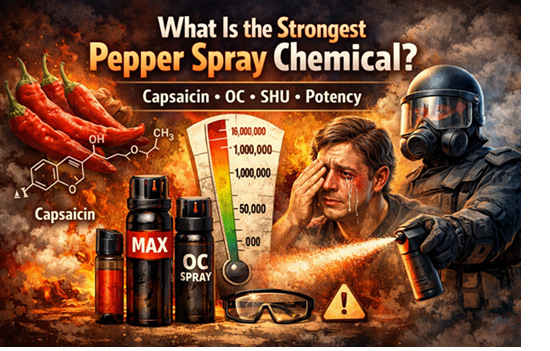
Capsaicinoids are traditionally measured using the Scoville Scale, a subjective measure of heat intensity in peppers. Pure capsaicin rates around 16–16.5 million Scoville Heat Units (SHU) — an extremely high irritant level.
In pepper spray, manufacturers often cite SHU equivalents based on the percentage of OC and typical capsaicinoid composition. For example:
- A spray labeled as 2% OC with a 2,000,000 SHU rating means that 2% of the formulation consists of capsaicinoids with a theoretical average heat of 2 million SHU.
However, SHU alone doesn’t directly quantify real human effects in defense scenarios.
4. Comparing Chemical Potency vs. Formulation Strength
Pure Capsaicin Is the Top of the Scale
Pure capsaicin is among the most potent naturally occurring irritants known in plant compounds. It is the benchmark for heat at ~16 million SHU. But pepper sprays do not use pure capsaicin:
- Pure capsaicin is too potent and could pose safety risks.
- Practical formulas use OC extracts at regulated concentrations (often 1–10% OC in civilian sprays).
So the question becomes:
Does a higher percentage of OC always mean a stronger spray?
Concentration Matters, But So Does Delivery
Pepper spray strength depends on both OC concentration and the delivery system:
- Concentration (% OC):
- Higher OC means more active irritant per unit volume.
- Consumer sprays typically range from 1% to 10% OC.
- Higher doesn’t always equal better in real scenarios due to recoil, spray pattern, and aim difficulty.
- Formulation Quality:
- The ratio of capsaicin to other components.
- Stability and consistency of extract.
- Spray Delivery:
- Stream vs. fog vs. cone patterns change effective range and dispersal.
- Range and accuracy can be as important as irritant strength.
- Propellant System:
- How well the spray reaches the target.
- Low-pressure aerosols are safer for close-range use.
5. Is There a “Strongest Chemical” in Pepper Spray?
If by “chemical” the question means an individual molecule with maximum irritant activity, then:
- Pure capsaicin is the most potent capsaicinoid used as a reference.
- Other molecules (dihydrocapsaicin, etc.) have similar but slightly lower potency.
However, in practical pepper spray formulations:
- There is no single “strongest chemical” used in legal self-defense sprays beyond the capsaicinoids.
- Strength is engineered via concentration, formulation, and distribution, not by introducing exotic or more harmful chemicals.
Manufacturers may tout higher concentrations or “maximum strength,” but such claims are regulated and often do not translate into proportionately greater defensive effectiveness.
6. Legal Limits and Safety Standards
Civilian Self-Defense Regulations
In many jurisdictions (such as the U.S.):
- Pepper sprays for civilian self-defense are regulated for safety.
- Law enforcement and military sprays use stronger formulations within legal parameters.
Capsaicin concentration limits are often set to balance effectiveness with safety:
- High concentrations increase risk of excessive harm.
- Regulations aim to keep products non-lethal and reversible.
Law Enforcement and Tactical Sprays
Law enforcement sprays may use:
- Higher OC percentages
- Synthetic agents like PAVA
- Delivery systems designed for crowd control
These are not typically legal for civilian carry.
7. Safety and Ethical Considerations
Any discussion of pepper spray strength should include safety and ethical notes:
Health Risks
Irritant sprays can cause:
- Severe eye pain and temporary blindness
- Coughing, choking sensation
- Redness and inflammation
Individuals with respiratory conditions (asthma, COPD) can be at higher risk.
Appropriate Use
Pepper spray should only be used:
- As permitted by law
- In legitimate self-defense situations
Misuse can lead to criminal charges, civil liability, or serious injury.
Training and De-escalation
Effectiveness increases when users:
- Practice deployment (ideally with inert trainers)
- Know local laws
- Prioritize avoidance and de-escalation
Strength alone is not a substitute for situational awareness and responsible use.
8. Why “Strongest” Isn’t Always Best in Real Scenarios
Even if a theoretical “strongest chemical” existed, in practice:
- Accuracy and range matter more than sheer irritant potency.
- If you miss, potency doesn’t help.
- Spray pattern affects effectiveness.
- A focused stream may reach farther, while a broader cone increases hit probability at close range.
- Human variability influences response.
- Not everyone reacts the same way to OC or other agents.
- Wind, weather, and environmental conditions affect spray delivery.
Thus, a balanced formulation with good delivery and ease of use often outperforms a “stronger” but harder-to-handle product.
9. Synthetic Alternatives and Their Properties
Some jurisdictions allow or law enforcement uses synthetic irritants, such as:
PAVA (Pelargonic Acid Vanillylamide)
- A synthetic relative of capsaicinoids.
- Offers predictable chemical composition from batch to batch.
- Similar effects to OC but with different physical properties.
PAVA is not generally available for civilian defense in many areas. Its potency is comparable to OC but engineered for consistency.
CS and CN Tear Gases
Historically used in crowd control, CS and CN gases cause irritation of eyes, skin, and respiratory tract.
- CS (o-chlorobenzylidene malononitrile)
- CN (chloroacetophenone)
These are fundamentally different from capsaicinoid pepper sprays and are typically controlled substances.
Use in close quarters can be dangerous, especially for bystanders.
10. Breaking Down Common Misconceptions
“Higher % OC = Best Spray”
Not always true. Some sprays with mid-range OC and efficient delivery outperform high-OC sprays that are hard to aim or control.
“The Most Painful is the Most Effective”
Effectiveness isn’t about pain alone:
- Speed of symptom onset
- Duration of incapacitation
- Ease of use
- Legal compliance
matter more in self-defense.
“Synthetic Agents Are Superior”
Some synthetic irritants provide consistency but are not necessarily more effective or safer for civilians.
11. Real-World Defensive Effectiveness
Experts in personal safety often emphasize factors other than chemical strength:
- Training: Understand how to use your spray under stress.
- Situational Awareness: Preventing confrontations is primary.
- Legal Knowledge: Know what is permissible in your jurisdiction.
- Product Reliability: A dependable spray that dispenses consistently matters more than advertised strength.
A formula that is easy to deploy accurately and legal is more effective than a chemically potent but impractical alternative.
12. Health Outcomes, Recovery, and Aftercare
After exposure to OC pepper spray:
- Symptoms usually resolve in minutes to an hour.
- Flushing eyes with clean water and blinking helps recovery.
- Exposure to tear gas (e.g., CS) has different medical protocols; professional medical advice should be sought if symptoms persist.
Severe reactions are uncommon but possible, especially in individuals with respiratory conditions.
13. Legal Frameworks Around Pepper Spray Chemicals
United States
- Pepper spray containing OC is legal in most states for adults.
- Some municipalities limit concentration or require registration.
- It must not be carried on school grounds or into certain facilities without authorization.
Other Countries
Some countries restrict pepper spray to law enforcement or prohibit civilian ownership.
Always check local laws and comply with regulations.
14. Summary: What, Then, Is the “Strongest”?
- The most potent individual molecule used as a reference is pure capsaicin.
- Pepper spray formulations use oleoresin capsicum (OC) with varying concentrations of capsaicinoids.
- Strength claims are influenced by:
- % OC
- Spray delivery system
- Formulation quality
- No single “most powerful chemical” beyond capsaicinoids is used in legal civilian sprays.
- Practical effectiveness depends on delivery, training, and legal compliance.
15. Final Takeaways for Consumers and Safety Seekers
- Focus on reliability, range, and ease of use.
A well-designed spray you can deploy accurately matters more than chasing the highest percentage.
- Understand chemicals but prioritize safety.
Knowledge of OC and its effects helps you use pepper spray responsibly.
- Comply with legal limits.
Powerful chemical agents are often regulated for public safety.
- Train and prepare.
In high-stress situations, training improves outcomes more than potency.
See cost of pepper sprays